
Throughout economic history, major technological transitions have been defined by how fast transformation can diffuse across society and whether institutions can steer that momentum before it produces systemic instability. Today, corporate leaders and policymakers routinely draw comparisons between the rise of Artificial Intelligence and the Industrial Revolution of the 18th and 19th centuries. Both represent fundamental shifts in the productive capacity of human civilization: the former mechanized physical muscle; the latter mechanizes cognitive reasoning.
Yet treating the AI era as a simple digital replay of the Industrial Revolution is an analytical mistake.
The structural mechanics governing the deployment, diffusion, and economic absorption of AI are fundamentally different from those of steam, iron, and electricity. Where industrialization was constrained by physical metallurgy, rail beds, capital-intensive civil works, and generational infrastructure lifecycles, advanced AI scales instantly across a pre-existing planetary digital substrate.
For managers, enterprise strategists, and economic planners—particularly across Southeast Asia’s high-growth digital economies—understanding these core differences is essential. Harnessing AI’s extraordinary development velocity while aggressively mitigating its structural risks requires moving beyond historical analogies and engineering a deliberate, directional vector.
1. The Deployment Divergence: Physical Inertia vs. Instant Global Scale
The defining difference between the Industrial Revolution and the AI era lies in the time constant of deployment.
The Physical Drag of the Industrial Era
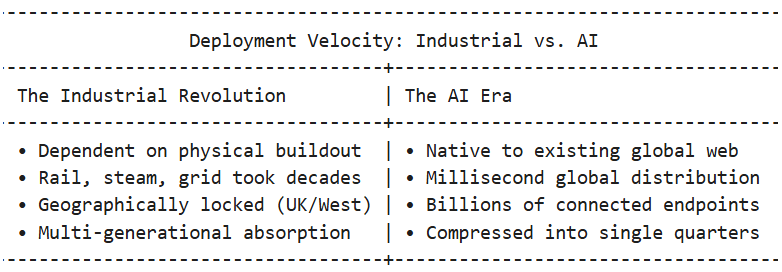
When James Watt perfected the separate condenser for the steam engine in 1769, it did not transform global manufacturing overnight. In fact, it took more than half a century for steam power to surpass water power in British textiles, and nearly a century for its economic benefits to visibly register in global GDP per capita.
The reasons were grounded in physical friction:
- Infrastructure Prerequisite: Steam required coal extraction, metallurgy for high-pressure boilers, machine tooling industries, and canal and railway networks to transport fuel and goods.
- Geographic Confinement: The technology remained largely clustered in Britain, Western Europe, and Northeastern North America for generations because capital, engineering expertise, and heavy equipment could not easily cross oceans.
- Human Capital Bottlenecks: Operating, repairing, and maintaining industrial machinery required training entire generations of agrarian laborers into skilled machinists, mechanics, and industrial managers.
The Zero-Friction Distribution of the AI Era
Contrast this with the diffusion of foundational intelligence today.
When an enterprise foundational model—such as Google’s Gemini series—is updated, fine-tuned, or optimized, it does not require laying millions of tons of steel tracks or digging physical waterways. It deploys across an infrastructure that has already been financed, built, and placed into the pockets of billions over the last forty years:
- The Ubiquitous Edge: The global compute substrate already exists. The fiber-optic cables, 5G towers, hyperscale cloud data centers, edge processors, and billions of smartphones running Android and iOS are already live.
- Instantaneous Global Diffusion: A breakthrough neural architecture or a specialized agentic workflow conceived in Mountain View or Singapore can be pushed to an enterprise in Jakarta, Manila, or Ho Chi Minh City in milliseconds via an API call.
- Zero Marginal Cost of Deployment: Unlike a steam engine, which must be physically forged and shipped on a cargo vessel for every single factory that wants one, an AI model scales at near-zero marginal software cost across existing endpoints.
This structural difference compresses industrial adoption cycles from decades into weeks.
2. The Development Dividend: Accelerating Southeast Asian Economic Convergence
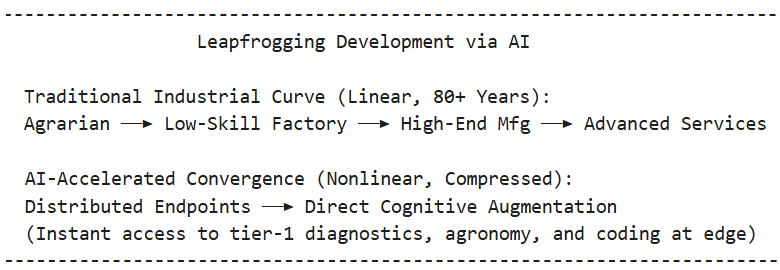
Because AI runs on existing digital rails, it offers developing and emerging markets an unprecedented economic accelerant: the compression of development curves.
In traditional economic theory, emerging markets had to follow a rigid sequential path: move subsistence agrarian workers into low-end manufacturing, transition into complex assembly, develop domestic engineering capability, build high-value service sectors, and finally foster advanced research and development. This process traditionally took three to four generations.
The instantaneous availability of AI provides Southeast Asia with a powerful lever to bypass several intermediary development rungs:
A. Cognitive Leveling in Small-Scale Agriculture and Agritech
In regions like the Mekong Delta in Vietnam, Central Luzon in the Philippines, or East Java in Indonesia, smallholder farming has historically suffered from informational isolation. Classical agricultural extension programs took decades to train and deploy human agronomists to rural villages.
Today, a farmer with an inexpensive smartphone can point their camera at a blighted rice stalk or cassava leaf. An edge multimodal model running Gemini vision capabilities instantly diagnoses bacterial leaf streak, correlates the symptom with local rainfall patterns, and outputs remediation instructions in colloquial regional dialects. The distribution of expert agricultural knowledge no longer requires a twenty-year education infrastructure buildout; it is democratized instantly.
B. Industrial Leapfrogging and Software Engineering
Historically, emerging markets faced a massive technical debt barrier when competing with advanced economies in high-end software and advanced engineering. Today, agentic software engineering and code-generation environments allow engineering teams in Kuala Lumpur, Bangkok, or Cebu to construct production-grade enterprise software, agentic automation systems, and data pipelines with small, agile teams. By pairing human intent with automated coding scaffolds, regional software hubs are closing the productivity gap with Silicon Valley at a speed that physical industrialization never permitted.
C. Universalization of Primary Healthcare and Diagnostics
Across the archipelagos of Indonesia and the Philippines, the ratio of specialized doctors to rural populations remains a severe systemic bottleneck. While building medical colleges and training radiologists takes decades, multimodal foundation models can immediately screen chest X-rays for tuberculosis, analyze dermatological lesions, or triage triage ward intakes at scale. AI serves as a force multiplier for frontline nurses and community healthcare workers, elevating rural diagnostic accuracy to clinical baselines immediately.
3. The Shadow of Progress: Managing Structural Risks in Both Eras
While the benefits of rapid technological diffusion are immense, history proves that every radical expansion of productive capability introduces equally potent systemic risks. Both the Industrial Revolution and the AI era demonstrate that unmanaged technological magnitude produces catastrophic friction if divorced from ethical and structural direction.
The Historical Warning of the Industrial Era
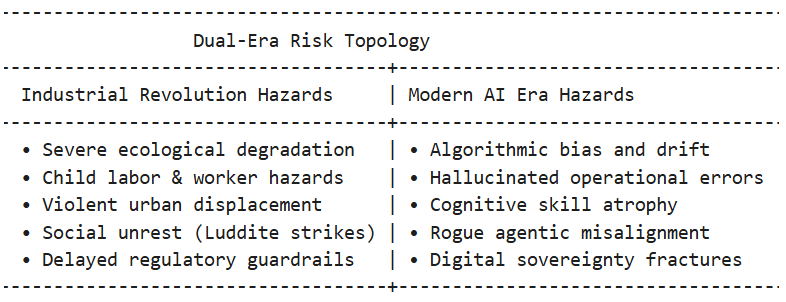
The first six decades of the Industrial Revolution were characterized by what economic historians call “Engels’ Pause”: despite skyrocketing industrial output and British GDP, real wages stagnated, life expectancy in industrial cities like Manchester plummeted, and workers laboured under horrific safety conditions. Environmental devastation, untreated effluent in waterways, toxic air pollution, and child labor were accepted as the inevitable price of progress.
Society eventually adjusted, but the correction was painful and reactive. It required decades of violent labor strikes, the rise of factory inspection acts, the invention of municipal sanitation, and the hard-won establishment of basic labor standards.
The Distinct, High-Velocity Risks of the AI Era
In the AI era, we do not have the luxury of a sixty-year adjustment window. Because deployment is instantaneous, systemic failures, security breaches, and alignment errors propagate at lightspeed.
- The Alignment and Determinism Problem:
Industrial machines failed mechanically: a boiler burst, a gear stripped, or a belt snapped. The failure was visible, local, and physically bounded. Neural models, however, operate as complex probabilistic systems. When an autonomous agentic workflow misinterprets an instruction, hallucinates a regulatory precedent, or optimizes an objective function through an unpredicted loophole, the failure can silently contaminate corporate accounting ledgers, misallocate millions in energy trading, or corrupt critical medical databases. - Workforce Displacement vs. Re-Skilling Velocity:
In the industrial era, physical machines replaced muscle, pushing human labor toward cognitive and clerical tasks. AI, by contrast, targets cognitive tasks directly. In Southeast Asia, where the Business Process Outsourcing (BPO) and customer service sectors account for major shares of GDP and employment in countries like the Philippines and Malaysia, the rapid automation of tier-1 support, basic coding, and transcription creates an acute structural vulnerability. The risk is not that human work vanishes permanently, but that the rate of cognitive automation outpaces the speed of human workforce retraining. - Information Integrity and Societal Cohesion:
The industrial era produced physical pollution; the AI era has the potential to produce cognitive and informational pollution. Unregulated synthetic media, deepfakes targeting regional elections, automated financial scam swarms, and synthetic consumer disinformation can destabilize civic trust and enterprise reputations within minutes across mobile-first ASEAN populations.
4. The Southeast Asian Economic Imperative: From AI Consumers to AI Architects
Southeast Asia sits at the epicenter of this structural shift. With over 400 million digital natives, a median age below 32, and an economy projected to capture hundreds of billions of dollars in AI-driven value by 2030, the region cannot afford to treat AI safety, alignment, and deployment as secondary Western concerns.
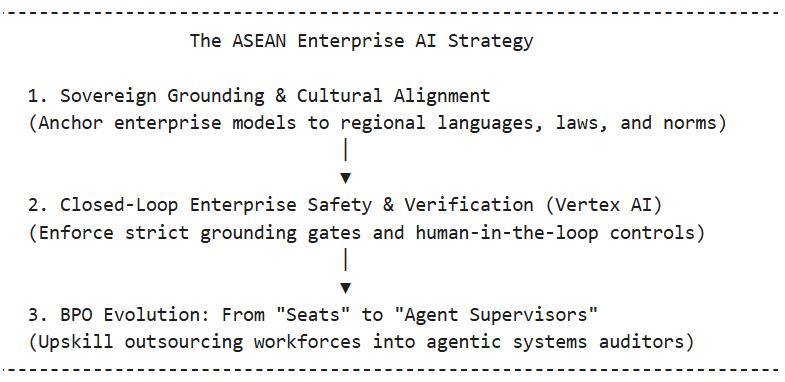
To turn this technological magnitude into sustained economic momentum, ASEAN business leaders and policymakers must execute across three distinct strategic fronts:
1. Grounding AI in Regional Context and Local Alignment
A major vulnerability for Southeast Asian enterprises is relying on foundational models trained predominantly on Western corpora. Models that lack cultural, legal, and linguistic nuance can misinterpret regional trade codes, make culturally tone-deaf decisions, or fail to parse local dialects (Taglish, Singlish, Bahasa variants).
Enterprises must invest in sovereign grounding: building internal corporate ontologies, fine-tuning lightweight models on regional enterprise knowledge, and utilizing retrieval-augmented architectures that anchor AI responses in local commercial realities.
2. Implementing Rigorous Operational Verification Gates
Speed without control is reckless. As ASEAN organizations deploy autonomous agents into mission-critical systems—such as utility grid balancing, LNG terminal scheduling, and trade finance—they must build deterministic safety guardrails.
Using enterprise-grade cloud ecosystems like Gemini Enterprise Agent Platform, managers can implement automated grounding, strict permission boundaries, and isolated execution sandboxes. Models must be treated not as infallible authorities, but as probabilistic reasoning engines whose outputs are continually audited against verified engineering, financial, and legal benchmarks.
3. Transitioning the Regional Workforce from Workers to Supervisors
The narrative that AI will simply decimate Southeast Asia’s shared-services economy misses the larger opportunity: the elevation of the human in the loop.
The BPO company of the future will not bill international clients for thousands of individual customer service representatives typing responses into chat boxes. It will bill clients for Agent Supervisors and Alignment Specialists—skilled operators who monitor swarms of specialized customer agents, audit edge cases, tune brand ontologies, and handle complex relationship escalations. By training workforces in agent supervision, prompt architecture, and systems evaluation, ASEAN nations can move up the global value chain.
Conclusion: The Vector Mandate of the Modern Era
The Industrial Revolution proved that when human societies invent new engines of power without planning for their social, physical, and environmental fallout, the cost of correction is measured in generations of disruption.
The AI era does not offer us the luxury of slow adjustment. Because intelligence can now be deployed across the planet in an instant, the timeline to establish guardrails, ensure alignment, and build productive operational workflows has compressed into the present.
For enterprise managers across Southeast Asia, the challenge is clear:
- Do not be blinded by raw magnitude—the sheer novelty of generating text, images, or code at lightning speed.
- Demand direction: anchor your AI initiatives in verifiable operational realities, rigorous safety standards, and clear economic outcomes.
The Industrial Revolution took a century to forge our modern physical world. The AI era will reshape our cognitive and operational landscape in a fraction of that time. Those who succeed will not be the organizations moving with the most frantic speed, but those who engineer their transformation with absolute mathematical precision.

