
Over the past three years, the corporate world experienced an unprecedented explosion of AI magnitude. Companies rapidly adopted conversational chatbots, used code assistants, and automated text generation. Yet, for all this feverish activity, executive dashboards reveal an uncomfortable truth: very few enterprises have achieved measurable displacement in operating margins, organizational velocity, or strategic defensibility. Most organizations simply bought a faster engine and bolted it onto a horse carriage.
At the Techsauce Global Summit, Dr. Kai-Fu Lee—founder and CEO of 01.AI, former President of Google China, and author of AI 2041 and AI Native: The Mandate to Transform Your Company—delivered a sobering critique of this piecemeal adoption.
His core thesis: You cannot become an “AI-augmented” company by sprinkling foundational models over 20th-century management hierarchies. Enterprises must become AI-Native.
Being AI-native does not mean running isolated generative pilots in marketing or customer service. It requires restructuring the operational fabric of the firm around three interconnected architectural pillars:
- Business Ontologies: Converting physical assets, workflows, personnel, and institutional logic into computable, machine-readable graphs rather than disconnected data silos.
- Multi-Agent Systems: Replacing static functional departments with networks of specialized, collaborative autonomous agents that execute multi-step workflows.
- Boss AI: Deploying centralized agentic decision-orchestration engines that synthesize operational reality, diagnose risks in real time, and convert strategic judgment into auditable closed-loop execution.
For service-heavy sectors across Southeast Asia—and specifically marketing agencies navigating the region’s diverse, multilingual commerce landscape—this paradigm shift is an existential fork in the road. Those clinging to the billable-hour model for creative execution are facing rapid obsolescence. Those restructuring into agentic operators are poised to capture unprecedented scale.
1. What “AI-Native” Actually Means: The Structural Evolution of the Firm
To understand Kai-Fu Lee’s framework, enterprise leaders must discard the notion that AI is simply a software upgrade like cloud computing or mobile migration.
In traditional (Software 1.0/2.0) organizations, humans act as the connective tissue. Information flows vertically through departmental silos (marketing, sales, legal, operations), gets bottlenecked in human inboxes, and is manually reconciled during weekly status meetings.
An AI-Native Enterprise, by contrast, inverts this flow:
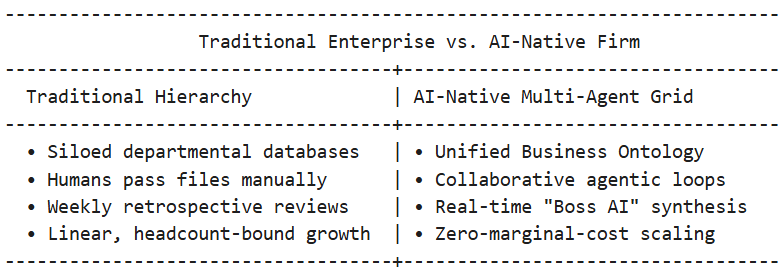
In Lee’s framework, an organization transforms through three operational layers:
Layer 1: Computable Business Ontology
Traditional data warehouses store passive tabular rows (sales orders, customer IDs, inventory counts). A business ontology models the operational entities of a business—people, physical assets, contractual constraints, vendor relationships, and operating rules—as an interconnected knowledge graph with semantic meaning. The AI does not merely query a database; it understands how a drop in supply in Vietnam impacts delivery schedules in Manila and what contractual penalties that triggers.
Layer 2: Multi-Agent Choreography
Instead of monolithic AI models attempting to do everything, tasks are distributed across specialized agents with bounded scopes of authority. A campaign plan is not written by one general model; it is co-created by a Creative Agent, audited by a Compliance Agent, stress-tested by a Budget Allocation Agent, and scheduled by a Media Buying Agent—all conversing and negotiating via structured protocols.
Layer 3: Boss AI (Executive Decision Engines)
At the apex sits “Boss AI”—an agentic executive decision layer. Boss AI does not replace the human CEO; it replaces the fog of war. It ingests the operational state of the entire multi-agent mesh, diagnoses margin drift, identifies operational friction before it appears on financial statements, and presents executives with scenario simulations and trackable action loops.
2. Immediate Impact on Marketing Agencies in Southeast Asia
Nowhere is the disruption of this model more immediate than among Southeast Asian marketing, branding, and media agencies.
For decades, the regional agency model thrived on labor arbitrage and fragmented markets. Holding companies and independent shops billed multinational brands for armies of copywriters, graphic designers, media planners, and localization coordinators across Singapore, Bangkok, Jakarta, Manila, Ho Chi Minh City, and Kuala Lumpur.
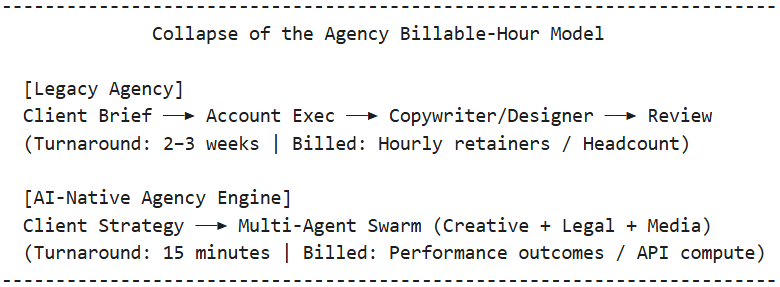
As Kai-Fu Lee points out, generative creation has collapsed to near-zero marginal cost. If an agency’s core value proposition is writing social copy, translating taglines into Thai or Tagalog, or laying out banners, enterprise clients will simply bring those functions in-house or bypass the agency entirely.
The New Agency Mandate:
Agencies across ASEAN must pivot from Content Factories to Agentic Systems Integrators.
Instead of selling headcount hours, modern agencies must build and manage proprietary multi-agent ontologies for their clients. The agency of record in 2026 is an architecture firm that designs, tunes, and governs brand-specific agent networks that execute hyper-localized, culturally attuned campaigns across Southeast Asia in real time.
3. Practical Architecture: Building an AI-Native Engine with Google Gemini
To see how Dr. Lee’s triad—Ontology, Multi-Agent Systems, and Boss AI—functions in practice, let us examine concrete scenarios built on Google Gemini Enterprise Agent Platform.
Gemini is uniquely suited for this architecture due to its massive multimodal context window, native tool-use (function calling) capabilities, and rigorous grounding mechanisms.
Scenario A: The Pan-ASEAN FMCG Launch (Ontology + Multi-Agent Swarm)
The Context:
A Singapore-based consumer goods enterprise is launching a new functional wellness beverage across Thailand, Indonesia, and the Philippines simultaneously. The campaign requires localized messaging, strict compliance with varying national health claim regulations, and dynamic budget re-allocation across TikTok, Meta, and Shopee.
Component 1: The Brand & Regional Ontology
Using Google’s Agent Search and Vector Search, the agency constructs a unified brand ontology:
- Product Nodes: Nutritional attributes, verified clinical study citations, certified halal credentials, and packaging dimensions.
- Jurisdiction Nodes: Thai FDA advertising limits, Indonesian BPOM health claim restrictions, and Philippine DTI promotional sales rules.
- Cultural Nodes: Localized idioms, seasonal holidays (e.g., Songkran, Ramadan, Barangay fiestas), and visual taboos across distinct ASEAN demographics.
Component 2: The Specialized Agent Mesh
Instead of a human team juggling spreadsheets and Slack channels, a multi-agent loop executes the workflow:
- Strategic Creative Agent (Gemini Flash): Drafts modular campaign concepts anchored to the brand ontology.
- Localization & Dialect Agents:
- Agent-TH: Adapts copy into nuanced, colloquial Thai, adjusting humor for Bangkok vs. Upcountry audiences.
- Agent-ID: Adapts messaging into formal and informal Bahasa Indonesia, verifying Halal-positive framing.
- Agent-PH: Adapts copy into Taglish (Tagalog-English mix) optimized for mobile social feeds.
- Regulatory Compliance Agent (Adversarial Auditor): Employs Gemini Enterprise Agent Platform Grounding with Agent Search against BPOM and FDA datasets. It flags unauthorized health claims (e.g., “This drink eliminates fatigue” is flagged and rewritten to “Supports natural daily energy recovery”).
- Media Optimization Agent: Interacts via API tools with regional ad managers to simulate initial bid rates and audience saturation.
Scenario B: “Boss AI” for Marketing Operations and Margin Defense
The Context:
The managing director of an agency network with offices in Jakarta, Bangkok, and Manila needs to track campaign health, resource utilization, and client churn risks without waiting for delayed monthly accounting reports.
How “Boss AI” Operates:
The agency deploys a centralized Boss AI orchestration agent powered by Gemini with access to the agency’s internal APIs (CRM, ad performance data, client communications, and time tracking).
- Continuous Operation Diagnosis: The Boss AI monitors real-time return on ad spend (ROAS) across 150 active regional client accounts. It detects that an e-commerce campaign in Indonesia has suffered a 22% drop in conversion efficiency over 48 hours due to an unannounced TikTok Shop algorithm update.
- Risk Identification: It cross-references this performance drop with customer sentiment in the client’s Slack channel, identifying that the client’s CMO has expressed dissatisfaction twice in the past 24 hours. The model flags this account as an elevated churn risk.
- Autonomous Remediation Loop: Boss AI does not just send a notification. It spins up a diagnostic task:
- It instructs the Media Agent to pause underperforming ad sets.
- It tasks the Creative Agent to generate three alternative visual hooks optimized for the new platform format.
- It drafts an executive incident memo for the Agency Account Director: “Client X performance dropped 22% due to platform shifts. I have prepared three remediated ad variants and temporarily reallocated $5,000 to top-of-funnel search. Review and approve the attached recovery plan before your 11:00 AM client call.”
The agency leadership shifts from reactive firefighting to reviewing pre-packaged strategic interventions.
4. Implementation Blueprint: How Organizations Transform
Transitioning to an AI-native organization cannot be achieved through a bottom-up grassroots experiment. As Kai-Fu Lee emphasizes, enterprise AI transformation is a top-down executive mandate.
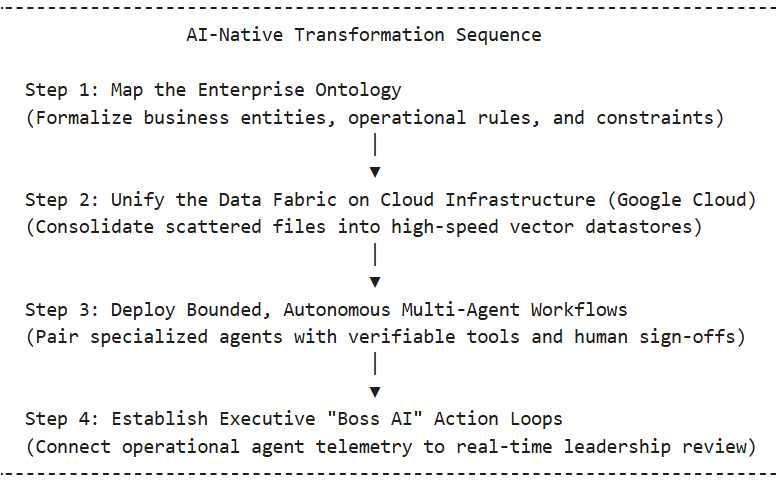
Step 1: Formalize Your Business Ontology
Before licensing more agentic software, map your organization’s knowledge domain. Document your brand guidelines, operational guardrails, pricing formulas, and regional regulatory constraints into machine-readable structures (JSON-LD, knowledge graphs, or structured vector stores). If your operational rules are not computable, your agents will hallucinate.
Step 2: Establish the Cloud Data Fabric
Multi-agent systems require low latency, reliable context sharing, and secure enterprise boundaries. Deploy on robust environments like Google Gemini Enterprise Agent Platform, ensuring that customer data, proprietary IP, and agency assets remain strictly isolated within private tenant spaces.
Step 3: Shift from Task Automation to Multi-Agent Delegation
Stop asking individual staff members to use AI to write emails faster. Redesign entire workflows:
- Define the input media.
- Define the specialized agent roles (Creator, Critic, Auditor, Executor).
- Set deterministic evaluation criteria (e.g., “Campaign cannot deploy unless Compliance Agent issues a 0.95+ support score”).
Step 4: Institute Boss AI Governance
Deploy executive-level oversight models that track the health of these agent swarms. Ensure that every autonomous loop has clear human-in-the-loop escalation gates when financial, brand, or regulatory risk exceeds predefined thresholds.
Conclusion: Direction Trumps Magnitude
Dr. Kai-Fu Lee’s address at the Techsauce Global Summit serves as a clear warning to modern managers: the era of treating AI as an optional productivity plugin is over.
Organizations that simply use AI to execute legacy workflows faster will find themselves outcompeted by lean, AI-native operators who have redesigned their entire operational model around multi-agent collaboration, computable business ontologies, and centralized executive intelligence.
For enterprises and marketing agencies across Southeast Asia, the path forward requires more than raw technical magnitude. It demands uncompromising strategic direction.

