
For decades, the enterprise software industry grew by adding magnitude through architectural complexity. If a business wanted to solve a new operational problem, it bought or built another application. That application required an entire stack: frontend UI, backend microservices, relational databases, user authentication, API connectors, third-party OCR engines, cloud hosting, and continuous maintenance.
Every corporate workflow became a patchwork of fragmented point solutions. Enterprise managers ended up managing the scaffolding—the glue code, login credentials, and data synchronization between apps—rather than the actual business outcome.
Recently, Andrej Karpathy articulated how modern multimodal AI makes that entire paradigm obsolete:
“MenuGen was a traditional web app: take a picture of a restaurant menu, OCR the dish names, generate images of the dishes, and render the result in a UI. It required frontend code, APIs, image generation, deployment, auth, payments, secrets, and infrastructure.
But later, I saw the Software 3.0 version: take a photo of the menu, give it to a multimodal model, and ask it to render dish images directly onto the menu image.
In that version, much of the app disappears. The neural network directly transforms input media into output media. The old software stack was scaffolding around a transformation the model can now perform directly.
This is one of the most important founder implications: AI is not just a faster way to build the old apps. Some apps should stop existing as apps.”
This is not a minor shift in software development; it is a fundamental restructuring of how enterprises process information. When a foundation model natively transforms input media directly into output media, the intermediary application layer dissolves.
To understand what this means for business marketing, analytics, and heavy industrial operations—specifically the rapidly expanding liquefied natural gas (LNG) sector in Southeast Asia—we must examine how AI is transitioning from a modular component into a direct, universal information transformer.
Who is Andrej Karpathy and Why Does His Insight Carry Authority?
Andrej Karpathy is one of the foundational figures of applied modern artificial intelligence. A founding research scientist at OpenAI, he later served as Senior Director of AI at Tesla, where he architected the computer vision and neural network pipelines powering Autopilot and Full Self-Driving (FSD).
At Tesla, Karpathy spearheaded the real-world shift from hand-crafted heuristic code to end-to-end deep learning. He demonstrated that instead of writing thousands of lines of C++ to detect lane lines, curb edges, and vehicle distances through modular sub-routines, a single deep neural network trained on raw photons could directly output vehicle steering, braking, and trajectory commands.
Karpathy introduced the taxonomy that explains this evolution:
- Software 1.0: Explicit, human-written code (Python, C++, Java) where programmers explicitly define every logic branch, rule, and algorithm.
- Software 2.0: Code written by neural network optimization weights, where humans curate datasets and loss functions, and machine learning models learn the underlying transformation functions.
- Software 3.0: Direct, end-to-end multimodal reasoning and agentic execution, where foundational models natively take arbitrary, unstructured inputs (images, audio, video, raw telemetry, text) and directly produce final structured artifacts or operational actions without intermediary application middleware.
When Karpathy observes that “some apps should stop existing as apps,” he speaks from deep operational experience in replacing complex software scaffolding with unified neural transformations.
The Dissolving Stack: How Software 3.0 Reshapes Business Functions
For enterprise leaders, the MenuGen anecdote reveals a universal pattern. Historically, because computers were rigid and models were unimodal, we built multi-layered software stacks simply to bridge format mismatches:
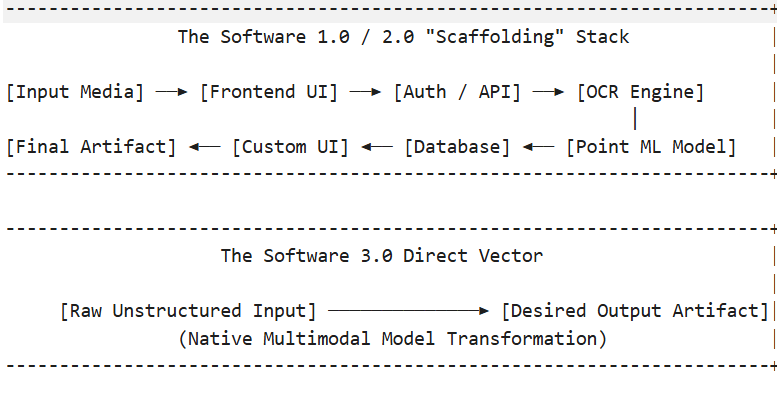
When an advanced multimodal foundation model like Google Gemini natively handles text, code, audio, high-resolution imagery, and video in an expansive context window, the intermediary stack becomes redundant overhead.
Here is how this direct transformation reshapes core business disciplines:
1. Marketing Operations: Eliminating the Content Assembly Line
- The Traditional Stack: Creating a localized technical campaign requires a multi-app pipeline: extracting technical specs from an engineering PDF, writing copy in a word processor, passing copy to a translation agency or localization portal, sending copy to a graphic designer using desktop publishing software, and having a compliance officer log tickets in a review platform.
- The Software 3.0 Transformation: The marketing manager uploads a high-resolution engineering diagram or product spec sheet directly into Gemini. The prompt instructs the model: “Translate this technical schematic into a localized, compliant digital infographic in Bahasa Indonesia, rendering the text labels directly into the image layout while applying regional regulatory disclaimers.” The translation, typesetting, layout adjustments, and claim grounding occur within the model’s direct multimodal processing. The entire pipeline of five SaaS applications collapses into a single direct transformation.
2. Data Analysis: From Data Warehousing Pipelines to Direct Querying
- The Traditional Stack: Analyzing operational performance traditionally requires an ETL (Extract, Transform, Load) pipeline: pulling raw CSVs or SQL dumps, writing Python scripts to clean null values, loading data into a business intelligence tool (like Tableau or PowerBI), configuring dashboards, and scheduling automated email reports.
- The Software 3.0 Transformation: An analyst drops raw, uncleaned telemetry logs, PDF invoices, and handwritten field operator logs directly into Gemini’s multi-million-token context window. The analyst asks: “Correlate the fuel gas consumption spikes on Line 2 with the atmospheric humidity logs from last month, identify anomalous thermal discrepancies, and render an executive variance table with recommended setpoint adjustments.” The model directly transforms unstructured raw inputs into final executive intelligence, bypassing data pipelines, schema modeling, and dashboard construction entirely.
3. Operations & Maintenance: Bypassing Specialized Field Software
- The Traditional Stack: Field technicians conducting physical equipment audits use dedicated mobile inspection apps. They fill out rigid dropdown forms, snap photos that require manual tagging, upload files to an Enterprise Asset Management (EAM) database, and wait for desktop engineers to review the entries.
- The Software 3.0 Transformation: A field technician records a 30-second walk-around video of a malfunctioning industrial pump while narrating what they hear and see. Gemini processes the combined audio-visual stream, recognizes the pump model from visual geometry, isolates the abnormal acoustic signature of cavitation, cross-references it against ingested OEM service manuals, and directly outputs an auditable, pre-filled work order ready for technician sign-off. The dedicated inspection software, the form builder, and the manual transcription app simply cease to exist.
Software 3.0 in Action: Southeast Asia’s LNG Industry
Southeast Asia’s liquefied natural gas (LNG) infrastructure is an ideal proving ground for this paradigm shift. As countries like Vietnam, the Philippines, Thailand, and Indonesia transition from domestic pipeline gas to imported LNG, their operational landscape is characterized by high physical complexity, multi-million-dollar cargo transactions, and disparate legacy software systems.
Using Google Gemini as an end-to-end multimodal transformer allows LNG operators and commercial desks to replace sprawling software scaffolding with direct input-to-output workflows that can be implemented immediately.
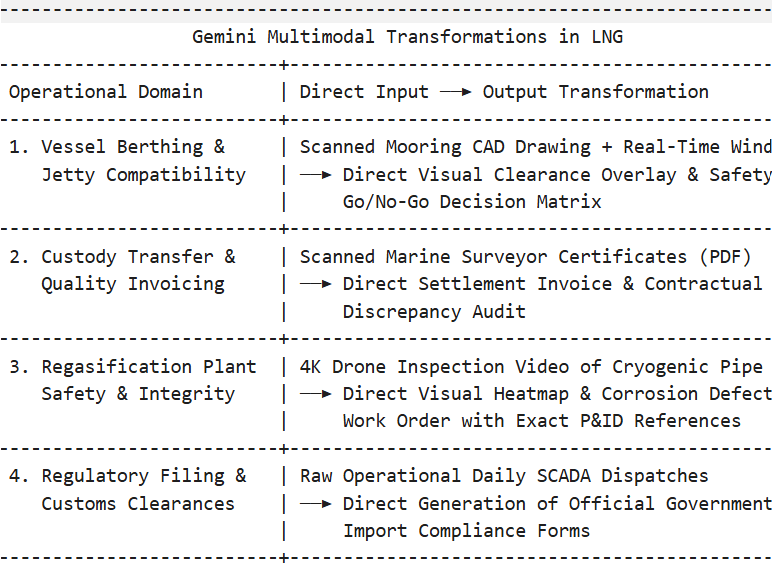
Use Case 1: Direct Jetty Compatibility and Mooring Safety Clearance
The Traditional Multi-App Scaffolding:
When an LNG carrier arrives at an import terminal (such as the Batangas FSRUs in the Philippines or Map Ta Phut in Thailand), port operations must verify jetty compatibility.
Traditionally, this requires a naval architect using dedicated berth-planning software, an engineer running separate tide/wind weather simulation tools, a logistics officer manually cross-checking physical manifold flange dimensions across vendor PDF datasheets, and an administrative assistant drafting the final Berthing Authorization Certificate.
The Gemini Software 3.0 Transformation:
- Input: Upload the arriving vessel’s 50-page technical specification drawing (PDF), a live aerial photo or CAD schematic of the terminal’s marine loading arms, and the real-time meteorological feed (wind speed, swell height, tidal currents).
- Direct Prompt:
“Analyze the manifold spacing and draft limits in this vessel blueprint against our terminal jetty layout. Evaluate whether the current 18-knot crosswind exceeds safe operational limits for our Chicksan loading arms. Render an updated visual clearance diagram directly highlighting manifold connection alignments and output a definitive Go/No-Go berthing decision with cited safety tolerances.” - Output: Gemini directly evaluates the spatial, mechanical, and environmental inputs, outputting the annotated visual layout and the safety clearance document in a single inference step.
- The Eliminated Stack: Specialized berth-planning CAD viewer, separate manual cross-referencing spreadsheets, and disconnected document generation software.
Use Case 2: Instant Custody Transfer Invoicing and Energy Content Reconciliation
The Traditional Multi-App Scaffolding:
When an LNG cargo offloads, the commercial value depends on energy content delivered (MMBtu), not simply liquid volume. The custody transfer process involves marine surveyor certificates, gas chromatograph readouts of methane/ethane/propane ratios, tank temperature/pressure logs, and boil-off gas calculations.
Traditionally, commercial analysts transcribe these figures into a custom ERP module, run external unit conversion scripts, cross-reference pricing formulas in an Excel model, and generate an invoice in their corporate accounting system.
The Gemini Software 3.0 Transformation:
- Input: Upload high-resolution scans or photos of the physical, ink-signed Certificate of Quality and Quantity (CQ&Q) issued by the independent marine surveyor, alongside the baseline Master Sales and Purchase Agreement (SPA).
- Direct Prompt:
“Extract the gross heating value, liquid density, and unloaded volume from these surveyor certificates. Calculate the net delivered MMBtu using the formula in Section 8 of the attached SPA. Account for contractual boil-off allowances, compare the result against the seller’s provisional bill, and render a final, audit-ready Custody Transfer Invoice directly in our corporate billing layout.” - Output: Gemini directly ingests the scanned physical documents, handles the mathematical unit conversions and contractual logic natively, and outputs the finalized, auditable settlement invoice.
- The Eliminated Stack: Dedicated OCR software, custom data-entry middleware, manual conversion spreadsheets, and specialized invoicing templates.
Use Case 3: Autonomous Cryogenic Pipeline Integrity Auditing via Multimodal Vision
The Traditional Multi-App Scaffolding:
At Southeast Asian regasification facilities (like Vietnam’s Thi Vai LNG terminal), maintaining the integrity of sub-zero cryogenic transfer lines and LNG storage tanks is critical. High ambient humidity and marine salt spray cause rapid corrosion under insulation (CUI) and flange leaks.
Traditionally, drone operators capture 4K video, technicians log timestamps manually, an image processing tool extracts frames, an NDT (non-destructive testing) specialist categorizes anomalies, and an asset management app generates repair tickets.
The Gemini Software 3.0 Transformation:
- Input: Feed the raw drone video inspection file (supported by Gemini’s native video processing) alongside the facility’s Piping and Instrumentation Diagrams (P&IDs).
- Direct Prompt:
“Inspect this drone flight video along the cryogenic transfer pipeline. Identify any signs of frost spots indicating insulation vacuum failure, weeping flanges, or external surface rust. For every anomaly detected, extract the exact timestamp, annotate the frame with a visual bounding box, correlate the physical location to the corresponding valve or pipe segment in the attached P&ID, and draft a prioritized maintenance ticket.” - Output: Gemini watches the video directly, identifies the physical anomalies, matches them to engineering schematics, and generates the complete, visual maintenance directive.
- The Eliminated Stack: Video editing tools, third-party computer vision classification APIs, manual tagging spreadsheets, and EAM ticket generation software.
Architectural Comparison: Software 1.0/2.0 Stack vs. Gemini Direct Transformation
To see how drastically this reduces enterprise overhead, consider the difference across operational dimensions:
| Operational Dimension | Software 1.0 / 2.0 (The Application Scaffolding) | Software 3.0 (Gemini Direct Transformation) |
| System Architecture | Fragmented stack: Web Frontend, Backend API, Database, Auth, OCR, Point ML, ERP integrations. | Unified Foundation Model: Direct media-in to media-out transformation via native multimodal reasoning. |
| Deployment Time | 6 to 18 months of software procurement, API integration, schema design, and user training. | Hours to days: Assemble ground truth documents and define the transformation prompt. |
| Data Format Handling | Rigid. Fails when a vendor changes a PDF layout, an image is blurred, or a column name shifts. | Resilient & Multimodal: Natively processes messy scans, natural handwriting, audio notes, and 4K video. |
| Maintenance Burden | High: API version breaks, database migrations, security patches, frontend framework updates. | Minimal: Model improves at the foundation level; maintenance shifts to prompt governance and grounding data quality. |
| User Experience | Navigating dozens of distinct tabs, software interfaces, passwords, and form fields. | Direct Intent: Provide input media; receive the verified, production-ready operational artifact. |
Strategic Blueprint: How Enterprise Leaders Can Prepare
As Karpathy highlighted, the primary risk for executives today is not adopting AI too slowly; it is wasting capital building modern versions of software that should not exist.
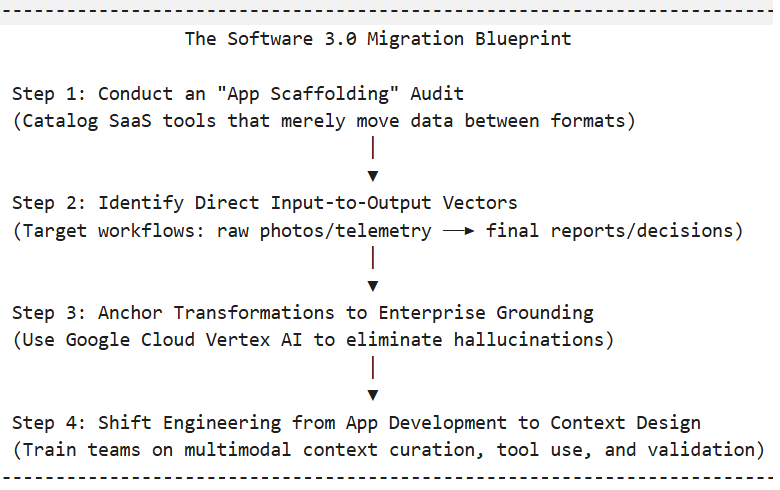
1. Conduct an “Application Scaffolding” Audit
Review your organization’s software budget. Ask of every tool: “Does this application perform genuine proprietary computation, or is it merely scaffolding that captures inputs, runs basic OCR or parsing, and displays it in another format?” If it is the latter, freeze long-term software development and explore direct multimodal transformation.
2. Prioritize Direct Multimodal Transformations
Look for operational bottlenecks where human labor is currently used as “human middleware”—manually looking at an image, PDF, or video and typing the information into an enterprise system. These are prime candidates for immediate Software 3.0 deployment using Gemini.
3. Anchor with Enterprise Cloud Grounding (Vertex AI)
Eliminating the application layer does not mean eliminating engineering discipline. Deploy transformations on secure, production-grade cloud environments like Google Cloud’s Vertex AI (now becoming Gemini Enterprise Agent Platform). Ground Gemini’s multimodal reasoning in your organization’s private technical manuals, contracts, and safety standards, ensuring that direct outputs remain mathematically and operationally verified.
4. Transition Engineering Teams to Context Architects
Your software engineers should not spend their careers building form UIs and CRUD (Create, Read, Update, Delete) APIs. Shift their focus toward context architecture and agentic engineering: designing robust validation gates, curating high-quality grounding datasets, and orchestrating models that transform raw operational realities into strategic business outcomes.
Conclusion: Stop Building Scaffolding. Build Vectors.
The greatest misconception of the generative AI era is that enterprise success comes from automating old software pipelines slightly faster.
As Andrej Karpathy made clear, true transformation occurs when the old stack disappears entirely. When multimodal models can directly convert messy, real-world inputs into verified, actionable outputs, maintaining brittle application scaffolding becomes an expensive operational distraction.
In Southeast Asia’s rapidly growing industrial and energy sectors, competitive advantage will not belong to the companies with the most enterprise software subscriptions. It will belong to the leaders who eliminate architectural clutter—harnessing the raw magnitude of Google Gemini and pointing it with surgical, directional precision.

